
§00 AIOS · FOR ESTABLISHED OPERATIONS · WORKING DOCUMENT, NOT A PITCH
An AI operating system
for the business you already run.
It learns how your operation actually works, reads your live systems, and briefs you every morning before the day starts. Then it takes over the repetitive work, biggest time cost first. You keep every system you have. You stop being the one who connects them.
§01 WHAT IT DOES, BEFORE ANY THEORY
Three things change in your week.
06:55, EVERY MORNING
A two-minute brief lands: what happened overnight, who owes you money, what needs your call today. Compiled from your systems while you slept.
ANY TIME YOU ASK
Plain-English questions get plain answers, source attached. Which customers slipped last month? Ten seconds, not a Friday afternoon.
MONTH BY MONTH
Repetitive work comes off your team's list, biggest time cost first: the hand-built weekly report, the invoice chasing, the double data entry.
§02 THE PROBLEM, STATED PLAINLY
Seven logins to answer one question.
The question is reasonable. What did we actually bill last month, and is it growing? The CRM has an answer. Billing has a different one. They disagree by a few thousand dollars, the spreadsheet that reconciles them lives on someone's desktop, and that someone is on leave until Tuesday.
So you do what you always do. You open the CRM, then the accounting system, then the ops platform, then the ticketing queue, then the spreadsheet, and by the time you have a number you'd defend, it's 9:40 and the day you planned is gone. The number was the easy part. The hour it cost is the product you keep paying.
Nobody sold you this workload. It accumulated, one sensible system at a time, and now the operation runs on you being the integration layer.
Buying an eighth system makes this worse, and you know that, which is why you've said no to every "AI transformation" pitch that landed this year. Most of them were right that AI could help and wrong about everything specific to how your business actually operates. The missing piece isn't another place for data to live. It's a layer that has read all seven, knows what you decided last quarter and why, and can hand you the answer before you ask.
That layer is what Zivah builds. The rest of this page explains the method, in the order it gets built, because the order is most of the method.
§03 WHAT AN AIOS IS
An intelligence layer wrapped around the operation you already run.
IN OPERATIONAL TERMS
- a.It holds your context. Strategy, people, pricing logic, the rules nobody wrote down.
- b.It queries your systems in plain English. One question, one answer, source attached.
- c.It writes you a brief every morning before the day starts, from your live data.
- d.It removes repetitive work in order of the hours each task costs you.
- e.It replaces nothing that works. Your systems stay. The layer sits above them.
§04 THE METHOD · FIVE LAYERS, BUILT IN ORDER
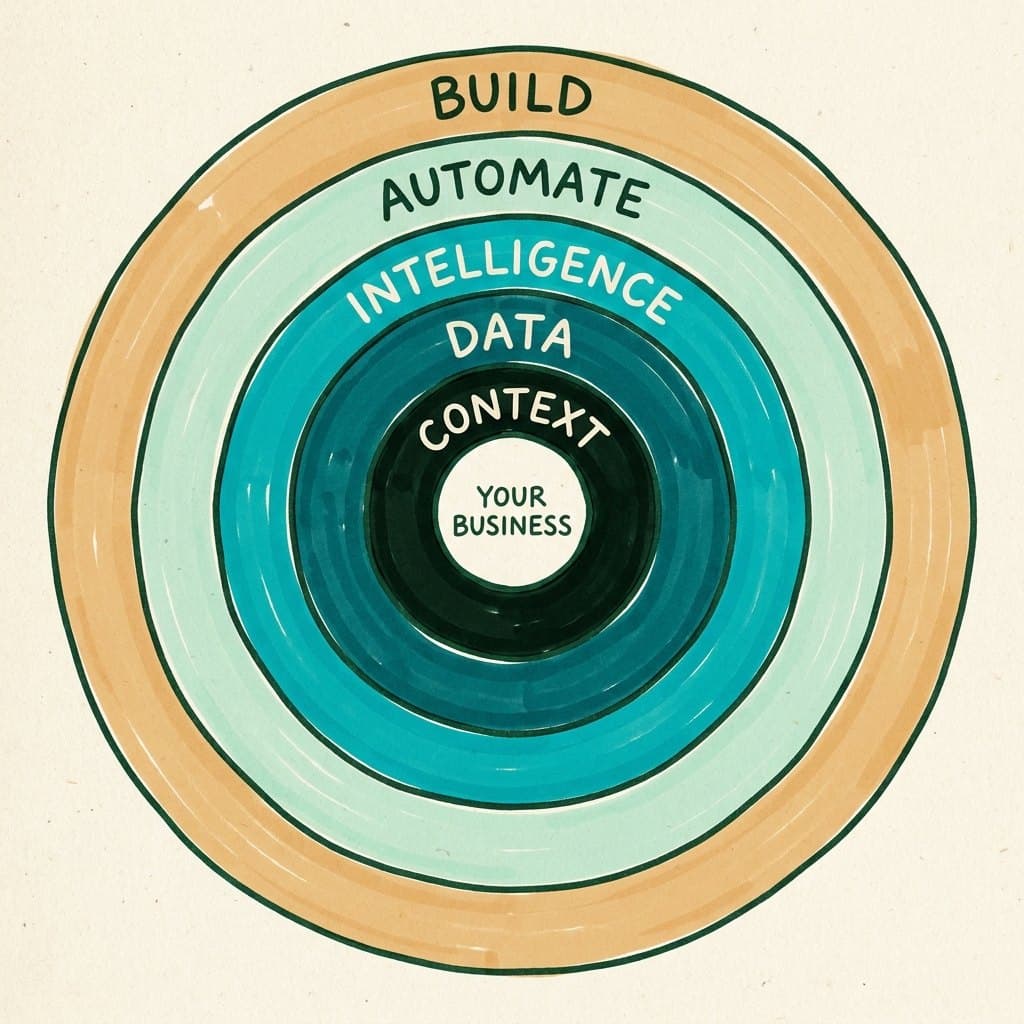
Each layer stands on the one below it. That's a constraint, not a diagram.
Most AI deployments fail the same way: automation gets bolted on first because it demos well, then produces confident work that's wrong in ways only you can catch. So you end up supervising the thing that was meant to relieve you. The layers below exist to prevent exactly that, which is why they land in this sequence and no other.
The system learns how your business actually runs.
Strategy, org structure, who decides what, how pricing really works, which customers get the bend-over-backwards treatment and why. The written material gets ingested; the unwritten rules get drawn out of your head in structured sessions and captured. From then on, every answer the system ever gives is grounded in your operation, not a generic model's guess about businesses like yours.
Why it's first: an AI with your data but not your context produces plausible answers with wrong assumptions underneath. That failure mode is worse than no AI, because it's confident.
↳ context established. now numbers can mean something.
Your systems become one queryable place.
CRM, billing, operations, support. Read-only connections pull them into a single layer you can question in plain English: which customers grew last quarter, what's our exposure to the top five accounts, which services are we under-billing. You get the answer and the source it came from, instead of seven dashboards and a reconciliation spreadsheet.
Why it's second: the question "is $41,000 a good month?" has no answer without layer one. Data lands after context so the numbers arrive with an opinion.
↳ the operation is now legible. now it can be watched.
The business develops a memory, and starts briefing you.
Meetings, calls and correspondence become searchable record instead of things someone meant to write up. Each morning, a synthesised brief lands before the day starts: what happened overnight, what moved, what's waiting on you.
Why it's third: a useful brief is a judgement call about what matters. Judgement needs both the context and the data underneath it.
↳ the system now understands the work. now it can take some.
Every repetitive task gets audited, scored, and removed.
This is the layer everyone wants first and nobody should get first. We inventory the recurring work across the business: the weekly report someone assembles by hand, the invoice chasing, the data entry between systems that don't talk. Each task gets scored by the hours it eats per month. Then automation proceeds down that list, highest cost first, with the system's context and data layers doing the judging a template never could. You see the list, the scores, and the order. You can veto any line.
Why it works here and fails elsewhere: by this layer the system knows your customers, your pricing, and your history. Automated work gets checked against all three before it leaves the building.
↳ the hours come back. the question becomes what to do with them.
The business builds again.
The point of the other four layers, and the only one that was never software: the founder or the leadership team gets their strategic hours back and spends them on the thing they were building before the operation swallowed the calendar.
Why a drawing, not a product screenshot: the claim is structural. The layers wrap your business, each ring only possible because of the one inside it, and the warm outer ring is the payoff.
MORNING BRIEF · TUESDAY · 06:55
compiled overnight from your systems · read time ~4 min| OVERNIGHT | · 2 items held for your call, both under |
| CASH | invoiced · collected · ⚑ one debtor crossed 60 days: |
| PIPELINE | moved to contract · quote expires Friday, no reply since |
| OPERATIONS | ticket volume normal · resolved without you |
| PEOPLE | returns Monday · handover note attached, one gap flagged |
| DECISIONS | 3 waiting · smallest first: |
§05 WHAT LANDS AT 06:55
A specimen, with the values blacked out. Because they don't exist yet.
This brief gets assembled at layer three, from your systems, overnight, every night. The sections are the standing skeleton; what fills them is whatever your operation did yesterday.
The first real one carries your numbers. It won't look like anyone else's, because no one else runs your business.
We considered filling this with impressive fake figures. Every vendor site you've seen this month did. It tells you more that we didn't.
§06 IN PLACE OF LOGOS
This is where the customer logos would go. We don't have any yet.
The AIOS is a new offering and we're not going to dress that up. No case studies, no "trusted by" strip, no borrowed credibility. What we can show you is mechanism, which has the advantage of being verifiable.
- Built byThe person you'd talk to.Founder-engineered. The engineer who designs your system is in the scoping conversation, the build, and the phone calls after it. There's no delivery team to be handed off to.
- Runs onInfrastructure already in production.Zivah runs AI voice agents for small businesses today, on infrastructure it hosts and operates itself. The AIOS is built on that same operational footing, not on a slide.
- MethodOn this page, not behind a form.The five layers above are the actual build sequence in the actual order. If a competitor wants to copy it, good. The method isn't the moat; executing it inside your business is.
- EntityZivah AI Pty Ltd, ABN 46 695 944 364.Australian-registered, Brisbane. Look us up.
§07 FIT, HONESTLY ASSESSED
WORTH A CONVERSATION IF
You're running something established, and it's running you back.
- You have real systems (a CRM, accounting, an ops platform) and the friction lives between them, not inside them.
- You can name, right now, the report someone rebuilds by hand every week.
- Leadership time is going to operating instead of building, and you can feel the difference in what's not getting done.
NOT FOR YOU IF
Some of the time, the answer is no.
- You're after an agent that answers the phone, books, and transfers, on a monthly plan. That exists, it's cheaper, and it's ours too: the Zivah Voice AI agent.
- You want transformation by Friday. Layer one is structured work and it involves your time as well as ours. Anyone promising otherwise is skipping it, and you now know what skipping it produces.
The next step is a conversation, on purpose.
There's no price list for this because the honest answer to "what does it cost" is "which tasks are eating your team, and how many hours." That's the first conversation: your systems, your recurring work, where the time goes. You'll leave with a clear picture of what an audit would find, whether or not we go further.
- i.You talk, mostly. Which systems you run, which reports get rebuilt by hand, what a normal Tuesday costs you.
- ii.We're specific back. Which layer addresses what, in what order, and what we'd need from you.
- iii.No deck, no follow-up sequence. If the fit isn't there, we'll say so in the room.